
Connect people, innovation, and investment to concrete needs.
Your Strategy 365 is a strategic consulting and advisory firm that helps companies, organizations, funders, and public leaders see opportunities they couldn't see before — and get to action without wasting time.
A structured way to make strategy visible so you can spend the time on doing, not describing.
We turn complex challenges into something you can navigate — bringing the data, the options, and the trade-offs into one shared view, so every decision is inspectable and defensible. We're not here to change businesses, or to convince people to do things that aren't in their interest. People won't do that, and it isn't sustainable. Instead, we make it possible for people to find strategic opportunities that are in their interest.
Structure the problem
Turn a sprawling challenge into a navigable map of the pieces that actually matter.
Make the data visible
Bring the evidence, options, and reasoning into one shared, explorable view.
Expose the trade-offs
Show what's chosen, what's rejected, and why — so every decision is inspectable and defensible.
Move to action
Connect the decision to the people, partners, and capital that make it real.
Our Engagements
We build each framework around a partner's strategic objectives — pulling the critical data into one manageable place and making it viewable from every angle. The result: transparent conversations that align teams and turn strategy into execution.
Technology Innovation Hub
We aligned a regional innovation partner's public and private stakeholders around one shared agenda — organizing the capabilities to pursue federal funding and drive economic growth.
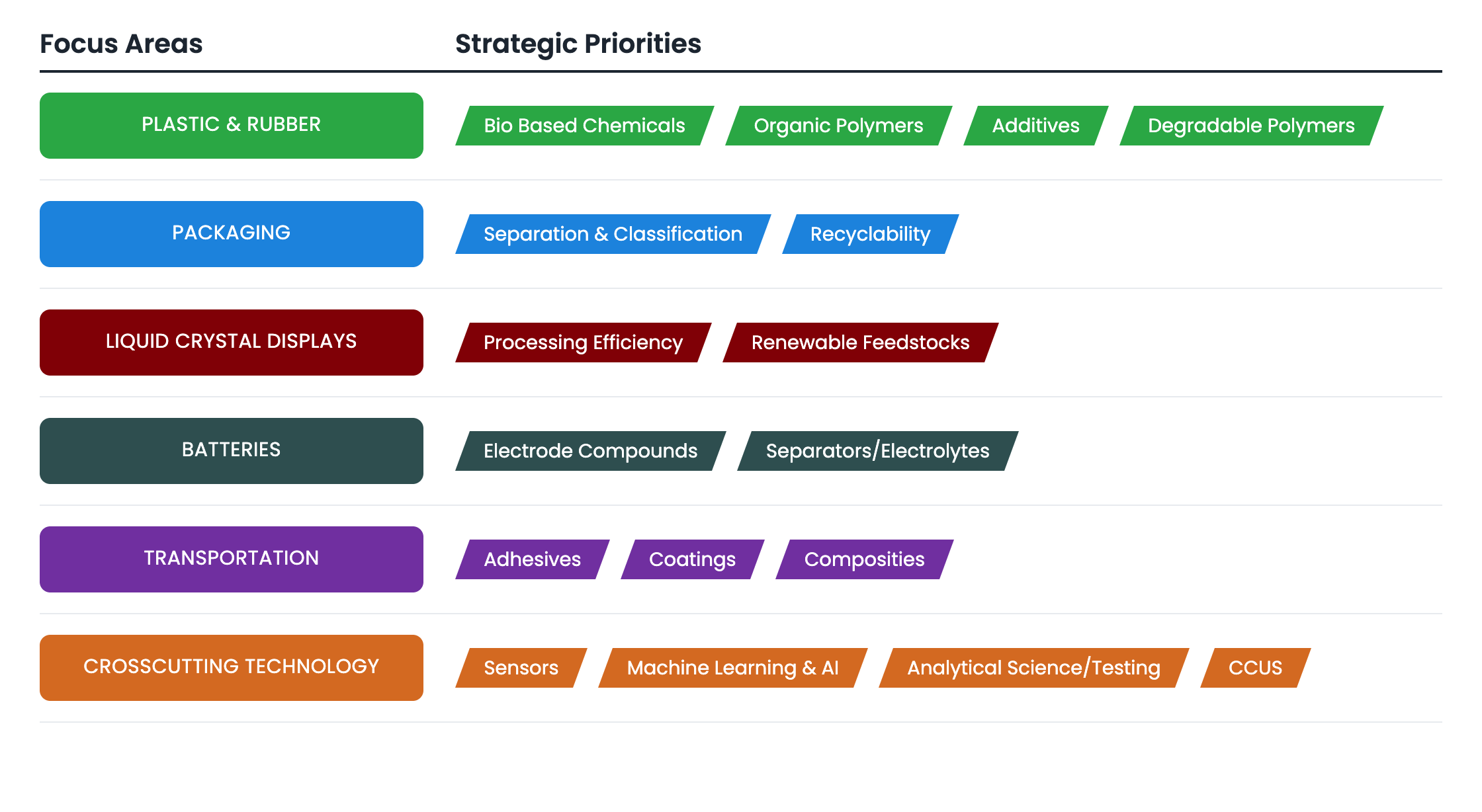
The data we bring together.
With the framework in place, we bring dozens of relevant datasets together, treating each one like a building block that we can snap together to assemble real solutions. It's not just exploring spaces — it's building strategic opportunities.
Strategic planning
Business priorities, desired outcomes, tactics & dates, decision-makers, policy, grants
Funding & investment
Venture and private-sector investments, investor and resource fundings
Private sector
Companies, commitments and connections, institute research
Research & partners
Research institutions, business partners, internal resources
People & organizations
Organizations and subgroups, users, alumni
Non-Profits & Philanthropy
Policy priorities and grant funding
Ready for people who have things to decide.
University Research Directors
Connecting research to commercial and business priorities
Decide which research capabilities and competencies are best positioned to advance solutions to solve business challenges and determine how to connect them to real corporate partners — turning a defined research base into a set of extendable capabilities.
Economic Development Leaders
Developing programmatic strategy & ecosystem connections to deliver organizational goals
Decide where to focus limited programmatic capacity to achieve the goals that matter by structuring initiatives and connecting them to corporate members, so priorities and the trade-offs behind them are explicit and explainable to stakeholders.
Corporate R&D / S&T Teams
Creating and updating research portfolios that stay tied to company objectives
Decide where to place research 'bets' against limited budget, tight timelines, and real business-driven needs — designing portfolios where every choice, and every rejected alternative, is inspectable and defensible.
Executives & Business Leaders
Prioritizing what to pursue as conditions keep shifting
Decide what to pursue when everything competes for the same time, budget, and attention — turning a crowded list into a set of priorities with clear strategic rationale, the trade-offs made, and the things chosen not to do, visible across the organization.
Life Sciences Development Leads
Advancing projects and programs that are better designed to deliver results
Decide which research programs to advance by designing a portfolio where project investment decisions are inspectable and defensible to a scientific committee, a board, or a regulator.
Philanthropy Program Officers
Turning ideas into fundable initiatives that drive scaled impact
Decide which interventions to fund when the evidence is incomplete and the stakes are human — with the reasoning behind each initiative or grant directly aligned to the needs of the board, partners, and communities served.
Government Policy Directors
Setting policy strategy to shape desired outcomes
Decide what policy to advance and where it leads — weighing priorities and second-order effects, with the assumptions, trade-offs, and rejected paths documented — so you can move decision-makers and deliver the win.
What changes when the picture gets clear.
Identify strategic spaces
Help organizations see the valuable opportunities they couldn't see before.
Cut the time and cost to action
Dramatically reduce what it takes to move from talking to doing.
Skip dead-end debates
Avoid wasting time arguing about things you already know you'll never do.
Mobilize sectors around one direction
Align the public and private sector on where the real opportunities are.
Target investment where it lands
Direct capital and effort to the places most likely to create impact.
Connect solutions to funders
Match potential solutions with the funders and investors looking for them.
Guide philanthropy
Point grantmakers toward the things that actually need funding.
Signal to investors
Show where things are going, where there's interest, and where there's a market.
We've been doing this long enough to know these things.
A lot of the people with critical things to contribute don't have anything to do with — and may not care about — the problem. We need to find ways to make them part of the solution.
It's impossible to find simple things. If you want to find anything, you've got to read everything.
The world is more interconnected than ever, and so are some of its biggest problems. But we still have no way to connect the pieces we need to solve them. That makes no sense.
Sometimes it's as simple as just seeing something. You can create a lot of value just by making it easy for people to see things.
We need to make complex problems tangible, accelerate the ability to create solutions, and increase the supply of innovation.
What Others Are Saying
“The worst mistake — and the most common one — is not having a strategy at all.”
By the numbers
Research on strategy execution
of organizations fail to execute their strategy
of employees don't understand their organization's strategy
of executive teams spend under an hour a month discussing strategy
of organizations don't link their budgets to strategy
Source: “Office of Strategy Management,” Harvard Business Review — Robert S. Kaplan, Marvin Bower Professor of Leadership Development, Emeritus, Harvard Business School; and David P. Norton, founder and director of the Palladium Group and co-author of The Balanced Scorecard.
Have strategic decisions you're trying to get right? Let's Talk.
Tell us what you're working on. We'll show you where the strategic spaces are.